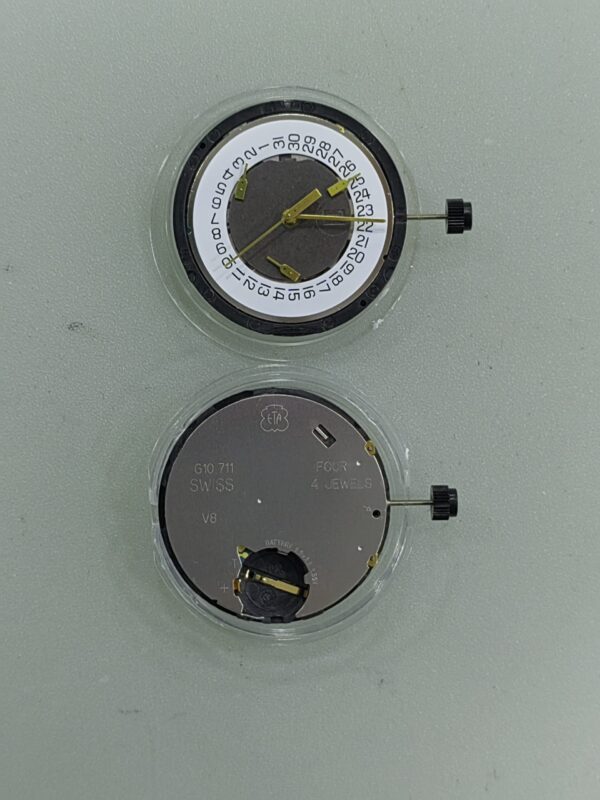
ETA G10.711 is a multi-functional quartz chronograph movement launched by the Swiss company ETA, and a core derivative model in the G10 series. It is distinguished by its modular design and diverse date display layouts. This movement was once widely used in the sports watch sector but has now been fully discontinued; current market circulation primarily consists of stock parts, with the official replacement model being the ETA G10.712 series. Its core value lies in balancing chronograph precision and functional expandability while offering high cost-effectiveness, ensuring a steady demand for maintenance and replacement even years after its discontinuation.
The ETA G10.711 movement has multiple sub-versions, with key differences in date display position and movement thickness, while core configurations remain consistent. This modular design allows it to fit watch cases of various styles.
- Size Specifications: All versions uniformly adopt a diameter of 13¼ lignes (approximately 29.8 mm), classifying it as a medium-to-large quartz movement suitable for watches with a case diameter of 40-46 mm. There are two crown specifications: the mainstream version uses the S 401-1497 model (10-tooth thread), while some sub-models employ the ETAG10211.405 crown, ensuring strong compatibility.
- Core Configuration: Equipped with 4 jewel bearings, mainly used to reduce friction in key gears of the chronograph module; it operates at a frequency of 32,768 Hz (the standard frequency for quartz movements) to ensure timekeeping accuracy. There are two hand hole specifications: 90/150/20 and 90/150/25, requiring the selection of compatible hands based on the specific watch model.
- Power System: Universally uses a 394-type battery (compatible with specifications such as SR936W and AG9), supplied by brands like Switzerland’s Renata. The battery life is approximately 2-3 years, depending on the frequency of chronograph function usage. It supports the hackable (second-hand stop) function, allowing the second hand to be stopped by pulling out the crown for precise time-setting.
Based on date display position and movement thickness, the ETA G10.711 is mainly divided into three sub-versions:
- 4:30 Tilted Date Version (D4:30A): The most recognizable version, with the date window located between the 4 o’clock and 5 o’clock positions at an inclined angle. The movement thickness is 5.62 mm, with an overall height (including components) of 7.9 mm. This version was once used in some TAG Heuer sports watch models; the tilted date design optimizes the dial’s visual balance.
- 6 O’clock Date Version (6): The date window is positioned at the 6 o’clock mark, with date numerals printed on the inner edge of the calendar disk. The movement thickness increases to 6.50 mm, while the overall height remains 7.9 mm. Due to the symmetrical date position, this version is often used in dress sports watches.
- 4 O’clock Inline Date Version (4S): The date window is located at the 4 o’clock position in a horizontal inline layout. With a thickness of 5.62 mm, it shares most components with the 4:30 version, differing mainly in the fixed bracket of the date module.
Centered on its chronograph function, the ETA G10.711 also integrates a date display. Its operational logic is straightforward, aligning with the usage needs of sports watches.
(说明:1. “石英计时机芯” 固定译为 “quartz chronograph movement”,“计时” 核心术语 “chronograph” 区别于普通 “timer”,为腕表行业专用;2. “法分” 作为机芯尺寸传统单位,保留 “lignes” 并补充毫米换算值,符合技术文档规范;3. 子版本代号(如 D4:30A、6、4S)、电池型号(394/SR936W/AG9)、表冠型号(S 401-1497/ETAG10211.405)均保留原文,避免信息偏差;4. “停秒功能” 译为 “hackable function”,为腕表领域描述 “秒针停走对时” 的专业表述,也可补充说明 “second-hand stop function” 以增强可读性;5. 品牌名(ETA、Renata、TAG Heuer)遵循 “名从主人” 原则保留原文,符合行业惯例。)



Reviews
There are no reviews yet.